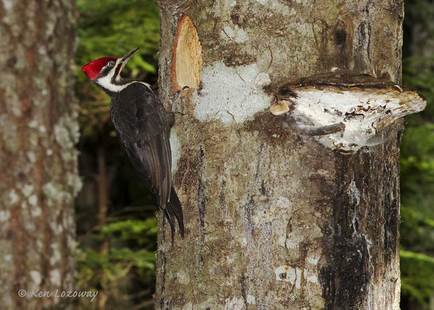
Week #5 (May 3 – 9) Observations were conducted on the 5th and 8th. Behavior typical of parents brooding nestlings continued and audible sounds are being heard coming from within the nest cavity. Hatchlings would have been born naked and helpless; remains of the yolk sac would still be attached to the abdomen; eyes would be covered with a membrane with no evidence of slits and upper and lower beaks would both be tipped with egg tooths.
Rapid growth in body length and wing chord would be occurring, and has been reported to slow in the second week as feathers begin to erupt. Traces of lines across the eyelid would have occurred on day 3-4 and the eyes would have opened by day 9-10. The newly hatched young have been reported being able to raise their heads and open their beaks by the end of the first week, and would be able to raise themselves on their legs and flex their toes. As the nestlings began molting into juveniles most body feathers would have erupted by day 7 and the red cheek stripe of a male bird would become visible by day 14. The young will be able to control their body temperatures after about day 10 at which time brooding behavior will stop.
Both parents appear to be foraging and feeding the young nestlings equally at intervals of between 35-60 minutes. On May 3rd I was hearing occasional rasping begging sounds coming from within the nest cavity, and stronger rasping sounding like a beehive were heard on May 9th. All feeding activity appears to be occurring within the nest, with parents arriving silently (no prior vocalizations) and briefly remaining perched outside the nest cavity entrance. They are then entering with only their tail feathers remaining visible outside the entrance and then disappear completely into the cavity. This type of behavior has been reported to occur when nestlings are 7-15 days old. After a minute or so the adult reappears at the entrance with a fecal sac and flies off. The fact that young are actually producing these is an important adaptation for the purpose of maintaining nest sanitation.
The image below is of the female about to leave the nest with a fecal sac in its bill.
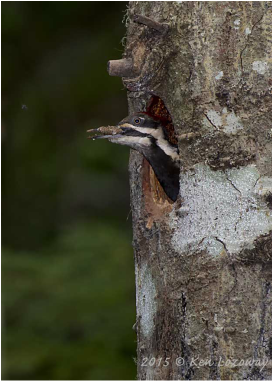
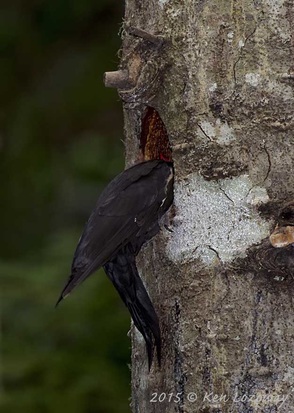
Later in the week I observed the adults feeding the young either partially in the cavity with lower body sticking out or with the entire body remaining outside of the cavity (see image above).
Additional observation during the week included the following:
Additional observation during the week included the following:
- adult birds have been vocalizing at a distance, presumably as they are foraging for food items;
- upon arriving for a feeding event they are perching on a tree near the nest tree for periods of up to 5-10 minutes, preening and bobbing their heads as if inspecting the tree for additional food items.
- Occasional drumming on a near by tree has also been occurring before a silent arrival is completed.
Week #6 (May10-16) Three juveniles are now appearing at the entrance begging for food. Feeding intervals have increased to between 40 & 80 minutes.
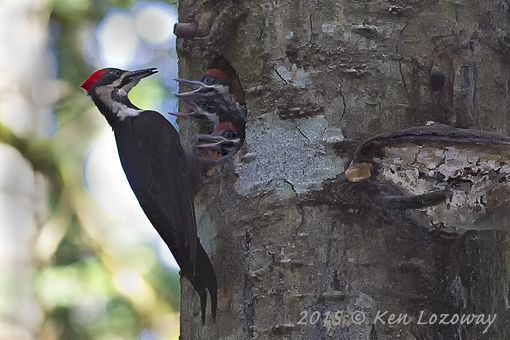
Young are being fed by adults regurgitating food and the food items are reported to consist of primarily invertebrates. They are now being feed while peering out the cavity entrance, giving repetitive yuk calls with raised crest, and rasping loudly while jabbing at the parents bill. The young beg to be fed and vocalize throughout the entire feeding interval. They then generally remain at the entrance for up to 2 minutes before disappearing back into the nest cavity. They are also giving a churring sound and a new adult-type vocalization sounding like a-nah. I have also begun hearing an occasional cuk sounding, suggesting the young are approaching 16-19 days old.
The image below is of the adult male regurgitating food prior to feeding the young juvenile. Notice the extremely long tongue.
The image below is of the adult male regurgitating food prior to feeding the young juvenile. Notice the extremely long tongue.
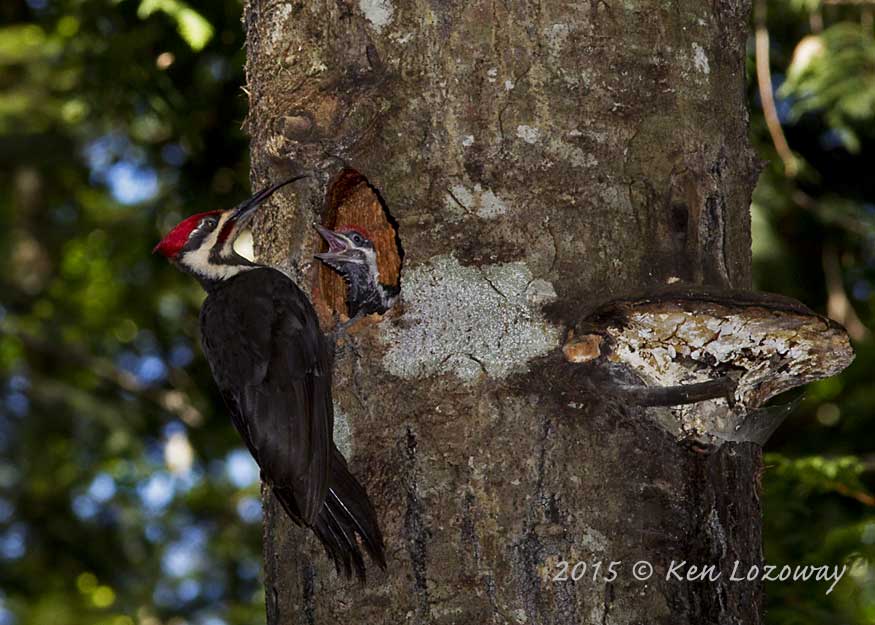
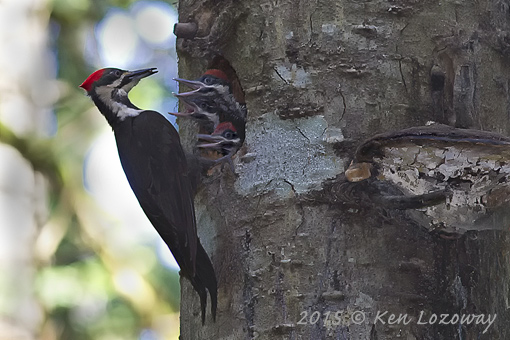
As illustrated in the image below the parents are feeding 3 healthy juveniles, and it appears there are 2 males and 1 female.
Their Their appearance at the entrance confirms they can now climb up the sides of the cavity. According to other researchers this behavior has been observed as early as days 11–13 and is well established by days 16–19. Towards the end of the week the young were being fed about every 60 – 90 minutes, and all feeding activity is occurring at the cavity entrance. Feeding intervals will apparently increase to every 2 hours next week. Young are being fed by adults regurgitating food items and then inserting their bills into the throat of the young. Food items are reported to consist mostly of invertebrates (grubs beetles insects). Adults are also vocalizing from a distance prior to arriving and again after leaving the nest tree.
Their Their appearance at the entrance confirms they can now climb up the sides of the cavity. According to other researchers this behavior has been observed as early as days 11–13 and is well established by days 16–19. Towards the end of the week the young were being fed about every 60 – 90 minutes, and all feeding activity is occurring at the cavity entrance. Feeding intervals will apparently increase to every 2 hours next week. Young are being fed by adults regurgitating food items and then inserting their bills into the throat of the young. Food items are reported to consist mostly of invertebrates (grubs beetles insects). Adults are also vocalizing from a distance prior to arriving and again after leaving the nest tree.
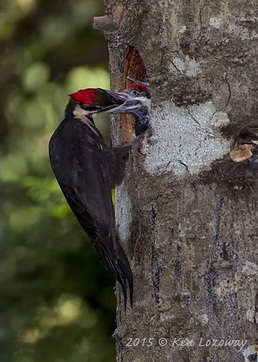
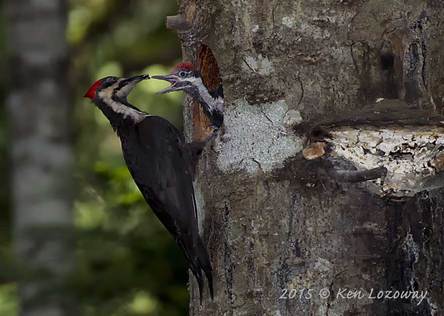
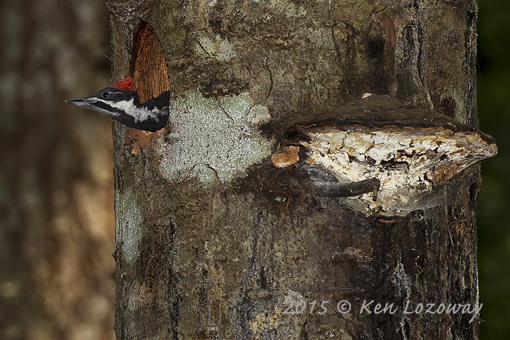
I've included the two images above to illustrate how quickly the juveniles are developing. The first image was taken on May 15th. The 2nd image was taken on Wednesday May 20; i.e. Week #7
Week #7 (May 17-23) In addition to taking more still images I also plan to shoot some video of the juveniles being feed.
Anticipate observing the following behaviors this week:
Anticipate observing the following behaviors this week:
- Parents will cease removing fecal sacs 2-5 days before the young fledge;
- Juveniles vocalizing, flexing their wings, and teetering on the rim of the nest cavity prior to actually leaving the nest.
- The young fledging and leaving the nest tree.