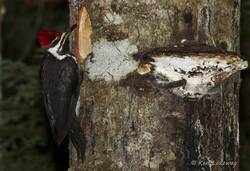
The return of a mated pair of Pileated Woodpeckers was a much anticipated and welcomed occurrence this year. Pileated Woodpeckers Dryocopus pileatus is the largest woodpecker found in North America. Best recognized by its large, dull black body and red head crest, they are generally found in deciduous, coniferous, or mixed forests in southern Canada. Nest cavities are usually excavated in dead and/or deteriorating live trees, whereas hollow trees are typically used for roosting.
I first discovered this nest site in the late spring of 2014, in a small mature stand of mixed temperate rainforest near Victoria, British Columbia. Although I was fortunate to observe the parents feeding 3 fully fledged young that day, I was disappointed to find the young birds had left the nest when I returned 4 or 5 days later.
Located in a small woodlot within an urban park setting, the nest tree is in a deteriorating fir tree approximately 50 meters high that already had two older nest cavities from previous years. The top portion of the tree is missing, most likely the result of wind damage. The current year's nest cavity is positioned approximately 180 degrees around and a bit lower from last years nest cavity.
Needless to say the opportunity to observe and photograph the pair raising another family this year, has thus far been providing some very unique images of nesting behavior. However I was somewhat concerned when I first visited the site in late February early March and found no evidence of nest cavity building. Undeterred I was excited to find the birds had returned and excavated a new nest cavity when I returned to the site in the first week of April. Evidence of the males prowess at selecting and excavating a new nest cavity was also quite evident from the huge amount of wood chips that lay at the base of the tree. The pair had most likely shared the territory all year, culminating in courtship and had probably intensified territorial behavior beginning in February-March.
I intend to observe this pair throughout the entire nesting, brooding and fledgling stages, and invite you to follow along as I post regular summaries and photos. So welcome to the first installment of what promises to be an exciting insight into the natural behavior exhibited by a pair of nesting Pileated Woodpeckers.
EGG LAYING & INCUBATION:
According to reports in the literature both adult birds incubate eggs alternately during the day, whereas the male incubates at night. Reported incubation periods vary between 15-18 days. The Incubating bird typically remains in the cavity until it's mate flies to the nest tree, passes it's head across the entrance hole, and then moves aside to let the incubating bird fly out (Bull and Meslow 1988).
Week #1 (April 5-11)
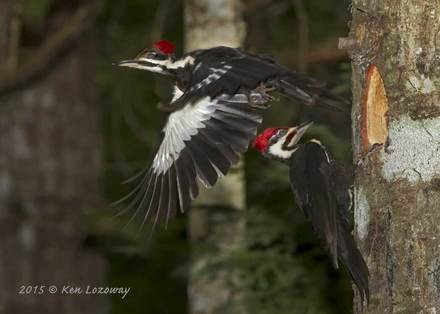
This week I observed the birds for 4-5 hours on two different days between the hours of 08:00 and 14:00 hrs. Both birds were taking turns inside the nest cavity, changing over approximately every 70-90 minutes. The inbound bird would generally fly into an area some distance from the nest site and begin vocalizing. The bird would then fly to a tree within the immediate area of the nest site and begin vocalizing and/or drumming on the tree. On two occasions the bird within the cavity responded by drumming back to the incoming bird. Usually within 2-5 minutes the incoming bird would appear at the nest tree and make it's way to the entrance hole. Both birds would then vocalize and complete the change over, with the outbound bird simply peering out just before launching itself out of the nest cavity. The bird sitting within the nest cavity rarely peered out from the nest cavity between rotations.
Week #2 (April 12-18)
The following observations were made on April 17th between 08:15 & 14:00. Although it's difficult to be certain, I suspect the birds are either incubating eggs or brooding very young hatchlings. Bird rotations occurred at 09:15, 10:20, 11:40, 12:10 and 13:30. Behavior and vocalizations were the same as described during week #1 with one exception. A Barred Owl appeared near the nest site at about 11:00 and perched in a cedar tree approximately 60-70 meters away from the nest tree. A Robin began vocalizing a typical alarm call as the owl moved around searching for prey beneath it's perch. The 11:40 rotation occurred with absolutely no vocalizations or drumming heard from the Pileated adults.
I can only assume the woodpeckers were attempting to avoid disclosing their nest location to the owl. Normal rotation behavior was observed for the 12:10 & 13:30 rotations, with vocalizations and drumming preceding each change over.
I first discovered this nest site in the late spring of 2014, in a small mature stand of mixed temperate rainforest near Victoria, British Columbia. Although I was fortunate to observe the parents feeding 3 fully fledged young that day, I was disappointed to find the young birds had left the nest when I returned 4 or 5 days later.
Located in a small woodlot within an urban park setting, the nest tree is in a deteriorating fir tree approximately 50 meters high that already had two older nest cavities from previous years. The top portion of the tree is missing, most likely the result of wind damage. The current year's nest cavity is positioned approximately 180 degrees around and a bit lower from last years nest cavity.
Needless to say the opportunity to observe and photograph the pair raising another family this year, has thus far been providing some very unique images of nesting behavior. However I was somewhat concerned when I first visited the site in late February early March and found no evidence of nest cavity building. Undeterred I was excited to find the birds had returned and excavated a new nest cavity when I returned to the site in the first week of April. Evidence of the males prowess at selecting and excavating a new nest cavity was also quite evident from the huge amount of wood chips that lay at the base of the tree. The pair had most likely shared the territory all year, culminating in courtship and had probably intensified territorial behavior beginning in February-March.
I intend to observe this pair throughout the entire nesting, brooding and fledgling stages, and invite you to follow along as I post regular summaries and photos. So welcome to the first installment of what promises to be an exciting insight into the natural behavior exhibited by a pair of nesting Pileated Woodpeckers.
EGG LAYING & INCUBATION:
According to reports in the literature both adult birds incubate eggs alternately during the day, whereas the male incubates at night. Reported incubation periods vary between 15-18 days. The Incubating bird typically remains in the cavity until it's mate flies to the nest tree, passes it's head across the entrance hole, and then moves aside to let the incubating bird fly out (Bull and Meslow 1988).
Week #1 (April 5-11)
This week I observed the birds for 4-5 hours on two different days between the hours of 08:00 and 14:00 hrs. Both birds were taking turns inside the nest cavity, changing over approximately every 70-90 minutes. The inbound bird would generally fly into an area some distance from the nest site and begin vocalizing. The bird would then fly to a tree within the immediate area of the nest site and begin vocalizing and/or drumming on the tree. On two occasions the bird within the cavity responded by drumming back to the incoming bird. Usually within 2-5 minutes the incoming bird would appear at the nest tree and make it's way to the entrance hole. Both birds would then vocalize and complete the change over, with the outbound bird simply peering out just before launching itself out of the nest cavity. The bird sitting within the nest cavity rarely peered out from the nest cavity between rotations.
Week #2 (April 12-18)
The following observations were made on April 17th between 08:15 & 14:00. Although it's difficult to be certain, I suspect the birds are either incubating eggs or brooding very young hatchlings. Bird rotations occurred at 09:15, 10:20, 11:40, 12:10 and 13:30. Behavior and vocalizations were the same as described during week #1 with one exception. A Barred Owl appeared near the nest site at about 11:00 and perched in a cedar tree approximately 60-70 meters away from the nest tree. A Robin began vocalizing a typical alarm call as the owl moved around searching for prey beneath it's perch. The 11:40 rotation occurred with absolutely no vocalizations or drumming heard from the Pileated adults.
I can only assume the woodpeckers were attempting to avoid disclosing their nest location to the owl. Normal rotation behavior was observed for the 12:10 & 13:30 rotations, with vocalizations and drumming preceding each change over.
Week #3 (April 19-25)
The following observations were made on April 24th between the hours of 12:00 & 14:00. The first change over occurred at 12:25 with the male replacing the female in the nest cavity. A distant vocalization was heard about 3-5 minutes before the male appeared in a tree near the nest site. However the exchange was completely silent with no additional vocalizations or drumming behavior.
A second silent change over occurred at 13:27 with no vocalizations heard prior to the rotation. However a distant vocalization was heard approximately 4-5 minutes after the female entered the nest, presumably made by the male. In both instances the adult birds completely entered the nest cavity without any prolonged hesitation. This suggests the hatchlings are still very young and helpless.
Given the time line to date I strongly suspect the parents are brooding/feeding newly hatched young birds. Hatchlings would have been born naked and helpless, with the remains of a yolk sac still attached to their abdomen. A rapid increase in body mass ca be expected over the first 13 days until weight is maximized by day 21. Between 7-10 days old the young will be feed inside the nest cavity by parents completely entering the cavity and regurgitating food, primarily invertebrates. The process involves the adult inserting it's bill into the throat of the young, followed by the young sucking and jerking it's head while the parent regurgitates.
Week # 4 (April 26-May 2)
As the young get bigger (7-15 days) they will be fed by an adult partially entering the cavity with it's tail sticking out of the entrance. Although not observed to date, this type of behavior is expected to occur this week. I don't anticipate seeing the nestlings peering out the cavity entrance waiting to be fed until they are 15-18 days old. Looking forward to this coming weeks observations/photo opportunities, and I will update this blog accordingly.
Nest site visits occurred on 04/28 & 05/2, and provided positive evidence of adult birds actively feeding newly hatched young within the nest cavity. Assuming an average clutch size of 3-4 eggs and reported incubation periods of 12 -14 days, the young are probably 10-14 days old. Although not observed, any dead young would have been carried away from the nest.
Sporadic vocalizations are occurring prior to the birds arriving at the nest tree, however silent arrivals are also being observed. Parents have also been heard vocalizing at some distance from the nest site, presumably while foraging for food items. Both parents have been observed to be
Feeding intervals are between 20 - 30 minutes apart, and adults are remaining outside the entrance for 2-3 minutes before entering. Occasionally the adult bird peers into the nest cavity before entering.
All feeding activity has been occurring within the nest cavity, and the adults generally exit the nest 5-10 minutes later. However I have also observed the parents staying inside the cavity for longer periods, averaging approximately 25-30 minutes, suggesting brooding behavior is still ongoing. Brooding behavior has been reported to cease after 10-14 days.
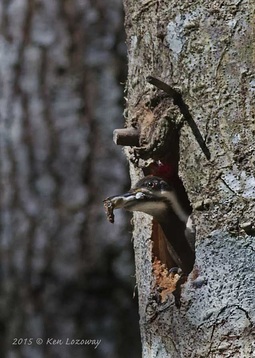
Adults have also been observed removing fecal sacs away from the nest by carrying them in their bills (see photo). This behavior is reported to cease 2-5 days before fledging.
The young have been heard giving a rasping begging call as they were waiting to be feed. On May 2nd the nestling vocalizations appeared to become louder, sounding much like a beehive. Nestlings have been reported giving a churring sound by days 14-15, and a new adult-type vocalization sounding like a-nah. By days 16-19 a cuk note has also been reported by other researchers.
Newly hatched young are reported to be able to lift heads and open beaks. By day 5 they can apparently raise themselves on legs and flex their toes. They have been reported climbing up the sides of the cavity by day 11-13 and may be able to reach the cavity entrance by day 16-19.
The following observations were made on April 24th between the hours of 12:00 & 14:00. The first change over occurred at 12:25 with the male replacing the female in the nest cavity. A distant vocalization was heard about 3-5 minutes before the male appeared in a tree near the nest site. However the exchange was completely silent with no additional vocalizations or drumming behavior.
A second silent change over occurred at 13:27 with no vocalizations heard prior to the rotation. However a distant vocalization was heard approximately 4-5 minutes after the female entered the nest, presumably made by the male. In both instances the adult birds completely entered the nest cavity without any prolonged hesitation. This suggests the hatchlings are still very young and helpless.
Given the time line to date I strongly suspect the parents are brooding/feeding newly hatched young birds. Hatchlings would have been born naked and helpless, with the remains of a yolk sac still attached to their abdomen. A rapid increase in body mass ca be expected over the first 13 days until weight is maximized by day 21. Between 7-10 days old the young will be feed inside the nest cavity by parents completely entering the cavity and regurgitating food, primarily invertebrates. The process involves the adult inserting it's bill into the throat of the young, followed by the young sucking and jerking it's head while the parent regurgitates.
Week # 4 (April 26-May 2)
As the young get bigger (7-15 days) they will be fed by an adult partially entering the cavity with it's tail sticking out of the entrance. Although not observed to date, this type of behavior is expected to occur this week. I don't anticipate seeing the nestlings peering out the cavity entrance waiting to be fed until they are 15-18 days old. Looking forward to this coming weeks observations/photo opportunities, and I will update this blog accordingly.
Nest site visits occurred on 04/28 & 05/2, and provided positive evidence of adult birds actively feeding newly hatched young within the nest cavity. Assuming an average clutch size of 3-4 eggs and reported incubation periods of 12 -14 days, the young are probably 10-14 days old. Although not observed, any dead young would have been carried away from the nest.
Sporadic vocalizations are occurring prior to the birds arriving at the nest tree, however silent arrivals are also being observed. Parents have also been heard vocalizing at some distance from the nest site, presumably while foraging for food items. Both parents have been observed to be
Feeding intervals are between 20 - 30 minutes apart, and adults are remaining outside the entrance for 2-3 minutes before entering. Occasionally the adult bird peers into the nest cavity before entering.
All feeding activity has been occurring within the nest cavity, and the adults generally exit the nest 5-10 minutes later. However I have also observed the parents staying inside the cavity for longer periods, averaging approximately 25-30 minutes, suggesting brooding behavior is still ongoing. Brooding behavior has been reported to cease after 10-14 days.
Adults have also been observed removing fecal sacs away from the nest by carrying them in their bills (see photo). This behavior is reported to cease 2-5 days before fledging.
The young have been heard giving a rasping begging call as they were waiting to be feed. On May 2nd the nestling vocalizations appeared to become louder, sounding much like a beehive. Nestlings have been reported giving a churring sound by days 14-15, and a new adult-type vocalization sounding like a-nah. By days 16-19 a cuk note has also been reported by other researchers.
Newly hatched young are reported to be able to lift heads and open beaks. By day 5 they can apparently raise themselves on legs and flex their toes. They have been reported climbing up the sides of the cavity by day 11-13 and may be able to reach the cavity entrance by day 16-19.