I have photographed this bird several times over the last 10 years, occasionally in BC but more often in Alberta. The most recent encounters occurred in several different locations in South-western Alberta.
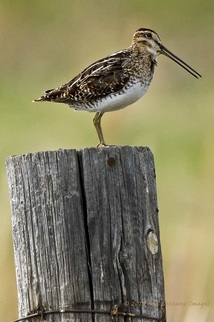
Perhaps my most memorable experience resulted in not only getting some fantastic images of a Wilson’s Snipe, but also capturing my first images of a Yellow-bellied Sapsucker. I was intently following and photographing a foraging Snipe when suddenly a Yellow-bellied Sapsucker appeared in my peripheral vision. Amazingly the bird had landed on a fence post not more than a meter and a half from where I was standing, partially hidden by a small stand of willows. Trying very hard to avoid startling the bird, I turned my body and camera very slowly through approximately 110 degrees, and managed to fire off 8-10 frames before the bird flew off. The experience once again reminded me that wildlife photography often involves hours of patience and persistence followed by seconds of mayhem. A little luck can also be helpful at times.
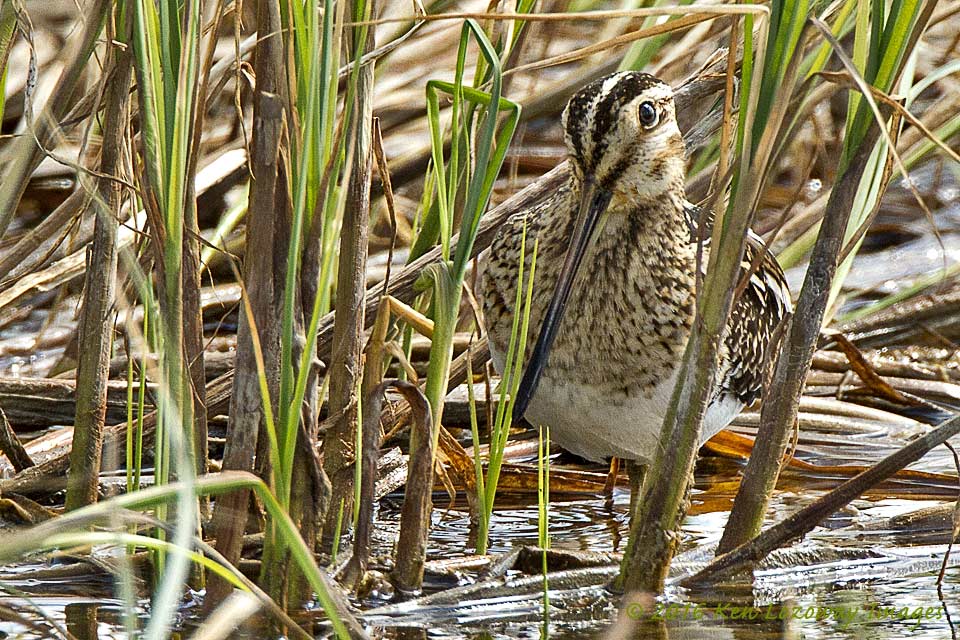
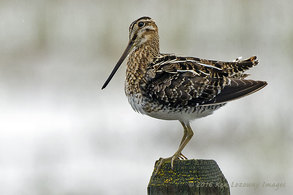
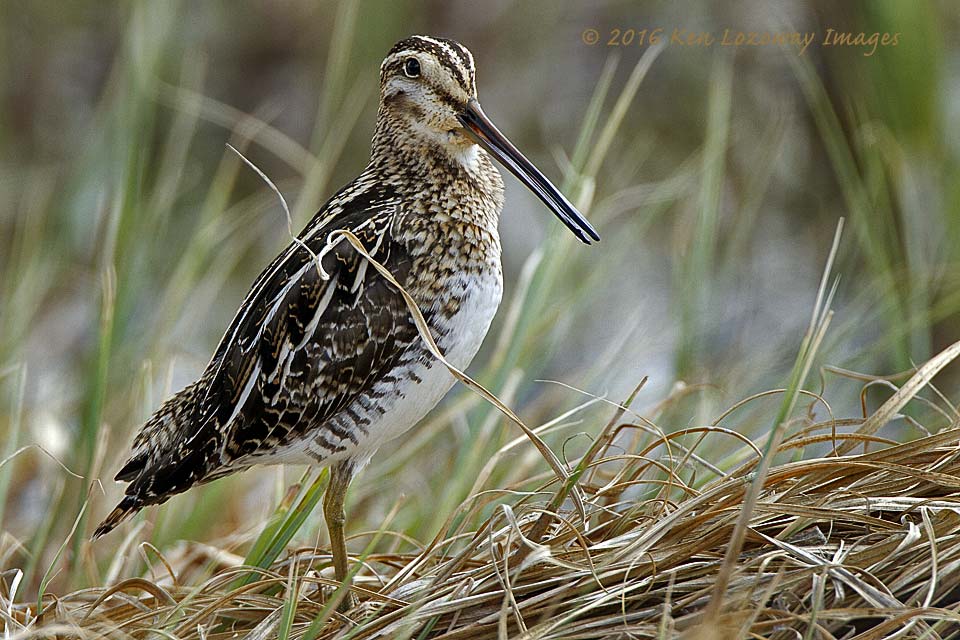
Wilson’s Snipe:
Order-Charadriformes; Family-Scolopacidae; Species-Gallinago delicate
Also known as the Common Snipe, this secretive and well camouflaged member of the sandpiper family has an unsettled taxanomic history; but is now classified individually. On its breeding grounds Wilson’s Snipe have been known to produce rather eerie sounds during their arial, mainly nocturnal, display flights. The birds tend to fly up silently from the ground, and then descend quickly from heights of up to 300 feet (100m) with their tail feathers spread, producing a unique, loud and vibrating sound through the modified tail feathers.
Order-Charadriformes; Family-Scolopacidae; Species-Gallinago delicate
Also known as the Common Snipe, this secretive and well camouflaged member of the sandpiper family has an unsettled taxanomic history; but is now classified individually. On its breeding grounds Wilson’s Snipe have been known to produce rather eerie sounds during their arial, mainly nocturnal, display flights. The birds tend to fly up silently from the ground, and then descend quickly from heights of up to 300 feet (100m) with their tail feathers spread, producing a unique, loud and vibrating sound through the modified tail feathers.
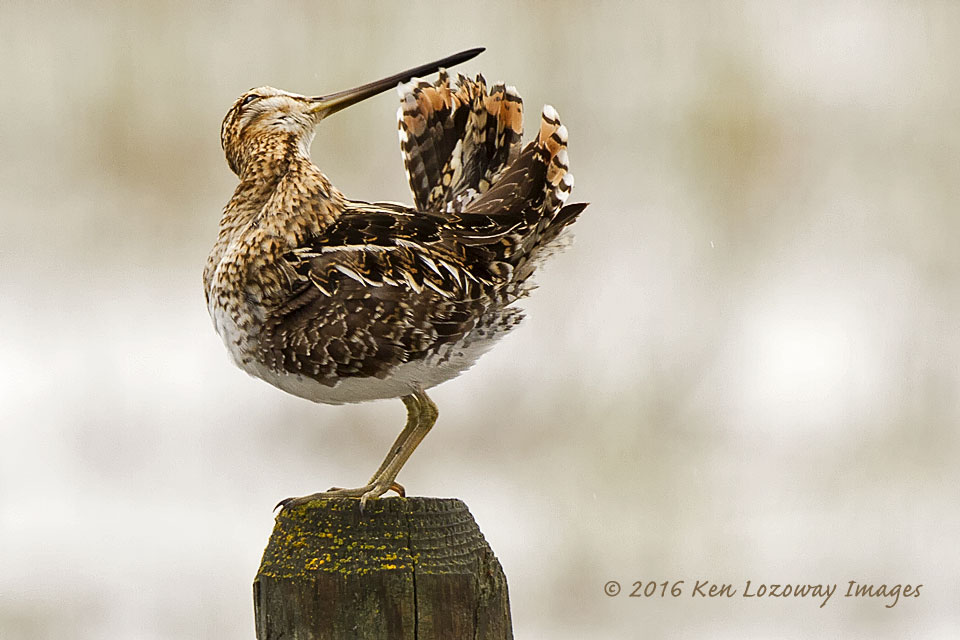
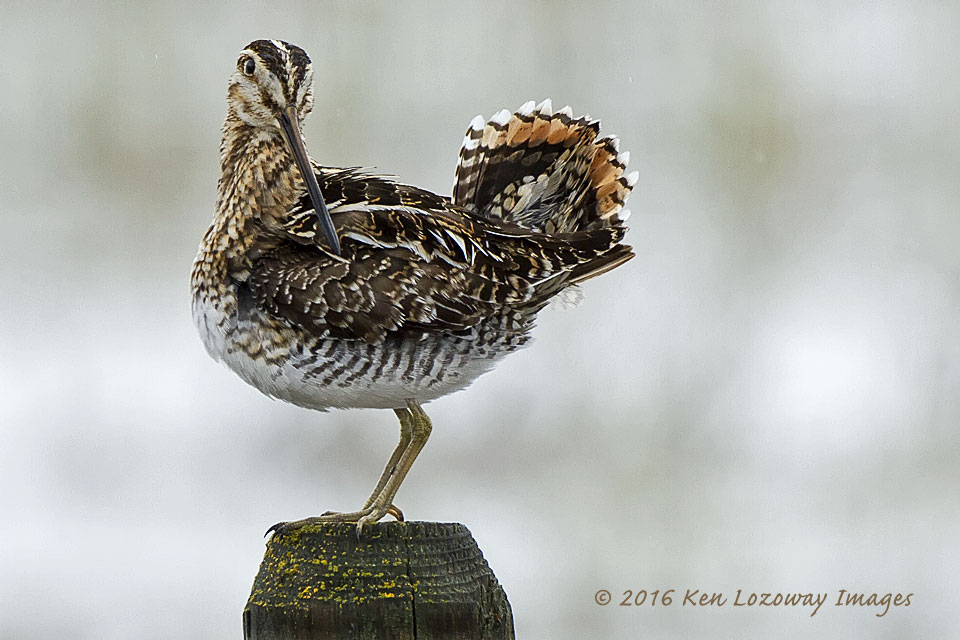
Wilson's Snipe preening & displaying modified tail feathers
Voice: Alarm and overhead flight call is a raspy kraitsch; perched and low flying breeding birds also give repetitive, monotonous kup-kuo-kup-kup in alarm or aggression displays; also known to produce distinctive whistling sounds during territorial displays.
Nesting: Elaborate woven nest lined with fine grass usually constructed on the ground, sedge, or moss.
Generally lay 4-eggs and produce only 1 brood in May-June.
Feeding: Forages in mud or shallow water; probes deep into subsoil; diet includes mainly insect larvae, but also crustaceans, earthworms, and mollusks.
Occurrence: Widespread from Alaska to Quebec and Labrador south of the tundra zone. Breeds in a variety of wetlands, including marshes, bogs, and open areas with rich soil. Winters further south, where it prefers damp areas with vegetative cover, such as marshes, wet fields, and other bodies of water.
Nesting: Elaborate woven nest lined with fine grass usually constructed on the ground, sedge, or moss.
Generally lay 4-eggs and produce only 1 brood in May-June.
Feeding: Forages in mud or shallow water; probes deep into subsoil; diet includes mainly insect larvae, but also crustaceans, earthworms, and mollusks.
Occurrence: Widespread from Alaska to Quebec and Labrador south of the tundra zone. Breeds in a variety of wetlands, including marshes, bogs, and open areas with rich soil. Winters further south, where it prefers damp areas with vegetative cover, such as marshes, wet fields, and other bodies of water.
(Information taken from Birds of Canada-David M Bird, Ph.D. First Edition 2010)
Shorebird photography can be exciting and rewarding, but it can also be very frustrating. Particularly if your subject matter happens to be a flock of smaller shorebirds like Dunlin or Black Turnstones. The foraging behaviour of these species usually involves a lot of stop and go type action as they move along the shoreline in small groups probing for food. Other species like the Wilson's snipe tend to be more secretive, and generally forage amongst bull rushes, sedges, and other types of aquatic vegetation, making it more difficult to capture images without a lot of extraneous unwanted elements in the frame. Here are some links to information I've found very helpful in raising my percentage of keeper images.
Helpful Links for Photographing Shorebirds:
1.) 6 Tips for Photographing Shorebirds - PhotoNaturalist
2.) Tips for Photographing Shorebirds - School of Digital Photography
NOTE: I hope you've enjoyed and found this post interesting and informative. Please leave your feedback & comments below, as I would like to make posts of this type a regular feature on the web site. Thank you.
Shorebird photography can be exciting and rewarding, but it can also be very frustrating. Particularly if your subject matter happens to be a flock of smaller shorebirds like Dunlin or Black Turnstones. The foraging behaviour of these species usually involves a lot of stop and go type action as they move along the shoreline in small groups probing for food. Other species like the Wilson's snipe tend to be more secretive, and generally forage amongst bull rushes, sedges, and other types of aquatic vegetation, making it more difficult to capture images without a lot of extraneous unwanted elements in the frame. Here are some links to information I've found very helpful in raising my percentage of keeper images.
Helpful Links for Photographing Shorebirds:
1.) 6 Tips for Photographing Shorebirds - PhotoNaturalist
2.) Tips for Photographing Shorebirds - School of Digital Photography
NOTE: I hope you've enjoyed and found this post interesting and informative. Please leave your feedback & comments below, as I would like to make posts of this type a regular feature on the web site. Thank you.